
HPV Vaccine for Children in India: Age, Safety & IAP Guidelines (2026)
Disclaimer: This article is for informational purposes only and should not replace professional medical advice. Consult your pediatrician before making vaccination decisions.
TL;DR: The HPV vaccine is recommended by the Indian Academy of Paediatrics for all children aged 9-14 (boys and girls). Two doses given 6 months apart provide over 97% protection against HPV types 16 and 18. Three vaccines are available in India: Cervavac, Gardasil, and Gardasil 9.
What is HPV?
Human Papillomavirus (HPV) is a group of more than 200 related viruses, of which at least 14 are classified as "high-risk" types that can cause cancer. HPV types 16 and 18 are responsible for approximately 70% of all cervical cancer cases worldwide [1].
HPV is not limited to cervical cancer. It causes several types of cancer in both males and females, including oropharyngeal (throat) cancer, anal cancer, penile cancer, and vulvar and vaginal cancers. Genital warts are caused by HPV types 6 and 11, which are also covered by all three vaccines available in India.
The virus is extremely common — most sexually active individuals will contract at least one HPV type during their lifetime. While the immune system clears most HPV infections within 1-2 years, persistent infections with high-risk types can progress to precancerous changes and eventually cancer over 10-20 years. This long lag time is precisely why vaccination before exposure is so effective.
HPV in India: The Numbers
India carries a disproportionate share of the global HPV burden. According to GLOBOCAN 2022 data from the International Agency for Research on Cancer [1]:
- 1,23,907 new cervical cancer cases are diagnosed in India each year
- 77,348 women die from cervical cancer annually in India
- India accounts for approximately 21% of all cervical cancer deaths worldwide
- Cervical cancer is the 2nd most common cancer in Indian women aged 15-44 years
- 1 Indian woman dies every 8 minutes from cervical cancer
These numbers are staggering, yet the majority of these cases are preventable. HPV vaccination before exposure to the virus can prevent over 90% of HPV-related cancers. Despite this, India's HPV vaccination coverage remains far below levels needed for population-level protection.
The economic impact is equally significant. Late-stage cervical cancer treatment costs lakhs of rupees and has poor outcomes, while HPV vaccination costs a fraction of that and prevents the disease entirely.
Who Should Get the HPV Vaccine?
The Indian Academy of Paediatrics (IAP) recommends HPV vaccination for all children — both boys and girls — starting at age 9 [3].
Recommended age groups
- Ages 9-14 years (ideal window): Children in this age group need only 2 doses and develop the strongest immune response. This is the best time to vaccinate.
- Ages 15-26 years (catch-up): Older teens and young adults can still benefit significantly but require 3 doses instead of 2.
- Immunocompromised children: Always require 3 doses regardless of age.
Common misconceptions about age
One frequent search query we encounter is "HPV vaccine for babies." To be clear: the HPV vaccine is not for infants or toddlers. The recommended starting age is 9 years. There is no benefit to vaccinating children younger than 9, and the vaccines are not approved for that age group.
Why boys need the HPV vaccine too
Many Indian parents assume HPV vaccination is only for girls because of its association with cervical cancer. This is incorrect. HPV causes:
- Oropharyngeal (throat) cancer — now the fastest-growing HPV-related cancer in males
- Anal cancer — affects both genders
- Penile cancer — affects males
- Genital warts — affects both genders
The IAP explicitly recommends HPV vaccination for boys using the same schedule as girls. For boys, Cervavac and Gardasil 9 are the approved options in India. Gender-neutral vaccination also creates community immunity, reducing HPV transmission for everyone.
IAP Vaccination Schedule
| Age Group | Doses Required | Schedule | Minimum Interval |
|---|---|---|---|
| 9-14 years (boys & girls) | 2 doses | 0, 6 months | 5 months between doses |
| 15-26 years (both genders) | 3 doses | 0, 2, 6 months | As per schedule |
| Immunocompromised (any age) | 3 doses | 0, 2, 6 months | As per schedule |
Key points:
- If your child starts the series before age 15, they need only 2 doses — even if the second dose is given after they turn 15.
- Missed doses do not require restarting the series. Simply continue from where you left off.
- The vaccine can be given alongside other routine immunizations at different injection sites.
Vaccine Comparison: Cervavac vs Gardasil vs Gardasil 9
Three HPV vaccines are currently available in India. All three are effective at preventing HPV-related cancers. Note: Cervavac and Gardasil 9 are approved for both boys and girls; Gardasil is approved for girls only in India.
| Feature | Cervavac | Gardasil | Gardasil 9 |
|---|---|---|---|
| Manufacturer | Serum Institute of India | MSD (Merck) | MSD (Merck) |
| HPV types covered | 6, 11, 16, 18 | 6, 11, 16, 18 | 6, 11, 16, 18, 31, 33, 45, 52, 58 |
| Cancer prevention | ~70% of cervical cancers | ~70% of cervical cancers | ~90% of cervical cancers |
| WHO prequalified | Yes (2024) | Yes | Yes |
| Approved for | Boys and girls | Girls only | Boys and girls |
| Approx. cost per dose | ~₹2,000 | ~₹3,900 | ~₹10,850 |
| Total cost (2 doses, ages 9-14) | ~₹4,000 | ~₹7,800 | ~₹21,700 |
| Total cost (3 doses, ages 15-26) | ~₹6,000 | ~₹11,700 | ~₹32,550 |
How to choose: All three vaccines provide strong protection against the most dangerous HPV types (16 and 18). Cervavac and Gardasil cover 4 types; Gardasil 9 covers 9 types and prevents up to 90% of cervical cancers. The best choice depends on your family's budget and desired coverage breadth. Your pediatrician can help you decide based on your child's specific situation.
Safety Profile
The HPV vaccine is one of the most extensively studied vaccines in the world. The safety data is clear and reassuring [4]:
- 135+ million doses have been administered globally
- 15+ years of post-licensure safety monitoring across multiple countries
- Serious adverse events are extremely rare — less than 3 per million doses
- No confirmed link to autoimmune conditions, infertility, or chronic illness
Common side effects (mild and temporary)
- Pain at the injection site — the most common side effect
- Mild fever — occurs in approximately 4% of recipients
- Headache and fatigue — resolve within 1-2 days
- Muscle or joint pain — temporary
What the research shows
A landmark 2020 study published in the New England Journal of Medicine followed 1.7 million Swedish women and found that HPV vaccination reduced the risk of invasive cervical cancer by 63% overall and by 88% when given before age 17 [2]. A Lancet meta-analysis of data from 14 high-income countries showed a 71% reduction in HPV infections among vaccinated populations within just a few years of programme introduction [5].
Common Myths vs Facts
Myth: "HPV vaccine is only for girls." Fact: The IAP recommends HPV vaccination for both boys and girls. HPV causes multiple cancer types in males, including throat and anal cancers. Gender-neutral vaccination is the global standard.
Myth: "HPV vaccine causes infertility." Fact: Multiple large-scale studies have conclusively shown that the HPV vaccine has no impact on fertility or pregnancy outcomes. The WHO, IAP, and every major medical body confirm this.
Myth: "My child is too young at age 9." Fact: Age 9-14 is actually the ideal vaccination window. Younger children develop a stronger immune response and need only 2 doses instead of 3. The vaccine works best when given before any HPV exposure.
Myth: "HPV vaccine encourages sexual activity." Fact: Multiple peer-reviewed studies have demonstrated that HPV vaccination has no effect on sexual behavior, age of sexual debut, or number of partners.
Myth: "HPV vaccine is for babies." Fact: The HPV vaccine is recommended from age 9, not for infants. It is not part of the infant immunization schedule. If you see "HPV vaccine baby" in search results, this is a misconception — the youngest recommended age is 9 years.
Government HPV Programme in India
India launched its national HPV vaccination programme in 2023 using Cervavac (manufactured by Serum Institute of India) for girls aged 9-14 in select states. The programme is being rolled out in phases and is expanding to additional states each year.
However, the government programme currently has some limitations:
- Only available for girls — boys are not yet covered
- Only Cervavac — Gardasil and Gardasil 9 are not included
- Limited geographic coverage — not yet available in all states and districts
In private practice, all three vaccines are available for girls, while boys can receive Cervavac or Gardasil 9. Parents who want to choose their preferred vaccine, need a flexible schedule, or want their sons vaccinated can do so through a private pediatrician.
Getting Vaccinated at KinderCure
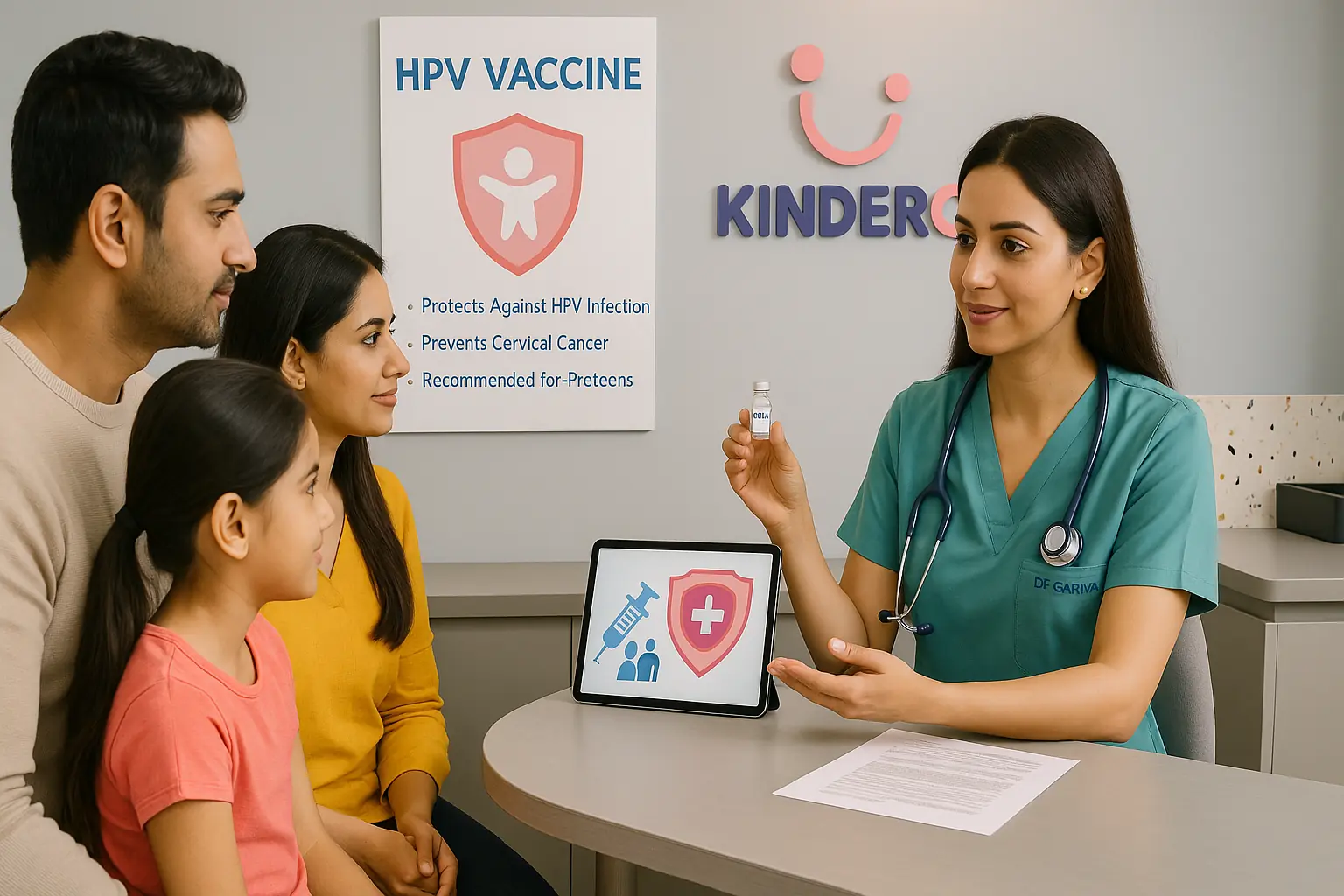
Dr. Garima Mengi provides personalized HPV vaccination consultations at KinderCure in Gurgaon. Each consultation includes a health assessment, discussion of vaccine options, and a recommended schedule based on your child's age and medical history.
Book an HPV vaccination consultation at KinderCure
Conclusion
The HPV vaccine is one of the most effective cancer prevention tools available today. With over 135 million doses administered globally and 15+ years of safety data, the evidence is overwhelming. Three vaccine options are now accessible in India — including the affordable, WHO-prequalified Cervavac — making HPV vaccination more accessible than ever.
The ideal time to vaccinate is between ages 9-14, when only 2 doses are needed and immune response is strongest. Both boys and girls benefit from vaccination. Talk to your pediatrician about the best option for your child.
Learn more about HPV vaccination at KinderCure
References
[1] GLOBOCAN 2022: India Factsheet. International Agency for Research on Cancer (IARC). https://gco.iarc.who.int/media/globocan/factsheets/populations/356-india-fact-sheet.pdf
[2] Lei J, et al. "HPV Vaccination and the Risk of Invasive Cervical Cancer." N Engl J Med. 2020;383:1340-1348. DOI: 10.1056/NEJMoa1917338
[3] Indian Academy of Paediatrics. IAP Guidebook on Immunization 2022-2025. https://iapindia.org/guidelines/
[4] World Health Organization. "Human papillomavirus vaccines: WHO position paper (2022 update)." Weekly Epidemiological Record. 2022;97(50):645-672. https://www.who.int/publications/i/item/who-wer9750-645-672
[5] Drolet M, et al. "Population-level impact and herd effects following the introduction of human papillomavirus vaccination programmes." Lancet Infect Dis. 2015;15(5):565-580.